Asana + Your Nervous System: A Better Way to Plan Your Day

Asana + Your Nervous System: A Better Way to Plan Your Day

I’ve been a project manager for over 20 years. I live and breathe in Asana.

Color-coded projects. Clean workflows. Automated task assignments. Perfectly organized boards that would make any PM jealous.

And yet, for years, my beautiful Asana setup was making me more stressed, not less.

Here’s what I didn’t understand: A well-organized task list can’t override a dysregulated nervous system.

Your body doesn’t care how clean your Asana board is. If you’re planning your day from a constant state of constant stress, even the best project management system becomes another source of overwhelm.

So I started asking a different question: What if we planned our days based on what our nervous system actually has capacity for?

The Problem with Traditional Task Management

Most productivity advice tells you to:

  • Plan your day the night before
  • Tackle the hardest task first (“eat the frog”)
  • Time-block your entire day
  • Batch similar tasks together
  • Use productivity techniques like Pomodoro

This isn’t bad advice. In fact, I use all of these strategies.

But here’s what’s missing: None of this accounts for your nervous system state.

What happens when you wake up with your chest tight and your breath shallow, but your task list says “Write proposal” at 8 AM?

What happens when you’ve had three difficult conversations in a row, and your system is flooded with cortisol, but your calendar says “Strategic planning” is next?

What happens when you’re running on empty, but your perfectly time-blocked day has no space for actual pause and regulation?

You push through. You override your body. You “should” yourself into burnout.

What Your Nervous System Actually Needs

Your nervous system has different capacities at different times.

Some days—or some hours—your system is regulated, grounded, and ready for complex cognitive work.

Other days (or hours), your system is activated, overwhelmed, or depleted. And no amount of willpower changes your actual capacity in that moment.

Here’s the truth most productivity systems ignore:

When your nervous system is dysregulated:

  • Your prefrontal cortex (decision-making, creativity, complex thinking) goes offline
  • Your working memory decreases
  • Your ability to focus diminishes
  • Everything feels harder than it actually is

Research published in Biological Psychiatry shows that chronic stress causes loss of spines and dendrites (branches and connection points) in the prefrontal cortex, directly impairing working memory and higher cognitive functions including decision-making and abstract thought.

You’re not being lazy. You’re not lacking discipline. Your biology is doing exactly what it’s designed to do.

So instead of fighting your nervous system, what if you worked WITH it?

How to Integrate Nervous System Awareness into Asana

This is where it gets practical.

I still use Asana for all my project management. But I’ve added one critical layer: energy tracking.

Note: I use Asana throughout this post, but these principles work in any task management tool—Trello, Notion, ClickUp, Monday.com, or even a paper planner. The tool doesn’t matter. The nervous system awareness does.

Here’s how it works:

Step 1: Create Your Energy System

The concept: Tag tasks based on the energy level they require.

Energy levels:

  • 🟢 Green Energy = Regulated, grounded, high capacity
    (Complex cognitive work, decision-making, creative projects, strategic thinking)

  • 🟡 Yellow Energy = Moderate capacity, some activation
    (Routine tasks, admin work, follow-ups, standard meetings)

  • 🔴 Red Energy = Dysregulated, low capacity
    (Simple tasks, physical tasks, organizing, strategic rest)

How to set this up in Asana:

If you have Asana Premium or higher (paid version):

  • Create a custom field called “Energy Level”
  • Set dropdown options: Green, Yellow, Red
  • Use color coding for visual clarity
  • You can also add a second custom field for “Actual Energy When Completed” to track patterns

If you have Asana Basic (free version):

  • Use tags instead: Create tags called “Green Energy,” “Yellow Energy,” “Red Energy”
  • Add the emoji to the tag name for visual distinction (🟢, 🟡, 🔴)
  • Tag each task with its energy requirement
  • Pro tip: You can also add the energy indicator directly in the task name, like: “🟢 Write quarterly strategy”

Tag tasks based on what they require, not when you plan to do them.

Examples:

  • “Write quarterly strategy” = 🟢 Green Energy
  • “Respond to routine emails” = 🟡 Yellow Energy
  • “File expense reports” = 🔴 Red Energy
  • “Organize digital files” = 🔴 Red Energy
  • “Brainstorm campaign ideas” = 🟢 Green Energy

This isn’t about priority—it’s about capacity.

Step 2: Check In With Your Nervous System BEFORE Planning

Every morning (or the night before), do a 2-minute body check-in:

  1. Close your eyes
  2. Take three deep breaths
  3. Notice: Where do you feel tension? Openness? Energy? Depletion?
  4. Ask: What color energy am I in right now?

Then build your day based on YOUR current capacity, not what the calendar says you “should” do.

Step 3: Match Tasks to Your Energy

Green Energy day?

  • Tackle the complex projects
  • Do the deep thinking work
  • Make important decisions
  • Have difficult conversations
  • Creative problem-solving

Yellow Energy day?

  • Handle routine tasks
  • Attend meetings (that don’t require heavy decision-making)
  • Do admin work
  • Follow up on projects
  • Process emails

Red Energy day?

  • Do simple, physical tasks
  • Organize your workspace or digital files
  • Update project statuses
  • Handle straightforward data entry
  • Take strategic rest (yes, this counts as productive)

The key: Stop forcing Green Energy tasks on Red Energy days.

Step 4: Build in Regulation Breaks

Here’s what changed everything for me:

I started blocking 10-minute “regulation breaks” between task blocks in my calendar.

Not “breaks” where I scroll Instagram. Actual nervous system regulation:

  • 3-minute body scan
  • Brief walk outside (my dogs love to join!)
  • Breath work
  • Gentle stretching
  • Lying on the floor (seriously)

These aren’t “nice to have.” They’re what allow you to maintain capacity throughout the day.

In Asana:

  • Create these as actual tasks: “🧘 Regulation Break – 10 min”
  • Schedule them between major task blocks
  • Mark them complete when you do them (this builds the habit)

What This Looks Like in Practice

Old way (ignoring my nervous system):

Monday morning, 8 AM: Develop 2 year complex project plan (because that’s what I planned Sunday night)

Reality: I’m tight in my chest, my mind is foggy, and I stare at a blank document for 90 minutes feeling like a failure.

New way (working with my nervous system):

Monday morning, 8 AM: Check in with my body. Notice I’m in Yellow Energy (moderate capacity, some Sunday scaries still lingering).

So instead: I spend 30 minutes organizing my Asana board, responding to straightforward emails, and doing a 10-minute grounding practice.

By 9 AM, I’m in Green Energy. NOW I develop the complex project plan. And it flows.

Same outcome. Half the time. Zero suffering.

The Asana Setup That Actually Works

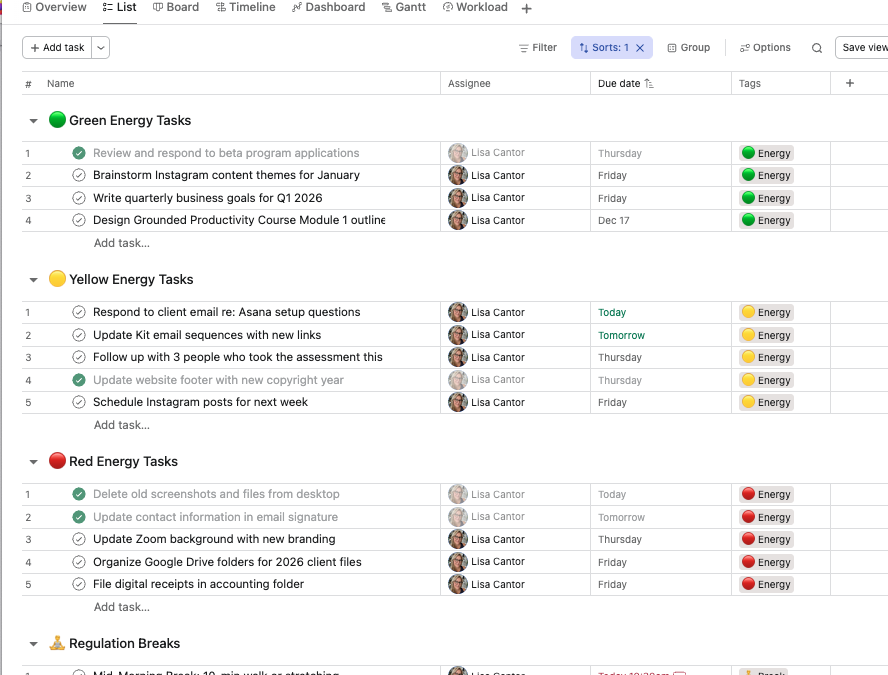
Here’s my exact Asana structure that honors nervous system capacity:

Project Organization:

  1. Daily Sections by Energy Level:

Create sections in your daily/weekly project:

  • 🟢 Green Energy Tasks
  • 🟡 Yellow Energy Tasks
  • 🔴 Red Energy Tasks
  • 🧘 Regulation Breaks (yes, I schedule these as tasks)

Free version users: This works perfectly with sections and tags, no paid features needed!

  1. Weekly Review Section:

Add a recurring task for weekly reflection:

  • “How was my energy this week?”
  • “What regulation practices helped most?”
  • “What tasks drained me that I can delegate/eliminate?”
  • “Patterns I noticed in my energy levels?”
  1. Additional Tracking (Optional – Premium users):

If you have Asana Premium, you can add these custom fields:

  • Energy level required (Green/Yellow/Red dropdown)
  • Actual energy level when completed (for tracking patterns)
  • Time estimate
  • Regulation needed after? (Yes/No)

This helps you spot patterns over time—like “Every time I do budgeting, I need Yellow Energy + a 10-minute regulation break after.”

My Daily Workflow:

Morning:

  1. 5-minute body check-in (not in Asana, just present with my body)
  2. Open Asana
  3. Look at today’s tasks
  4. Assess my current energy level
  5. Move tasks to the appropriate energy section for today
  6. Add regulation breaks between blocks

Throughout the day:

  • Check in with my body before switching tasks
  • Take scheduled regulation breaks (non-negotiable)
  • Notice when I’m pushing vs. flowing
  • Adjust the plan as my energy shifts
  • Move tasks between energy sections as needed

Evening:

  • 2-minute review: How did my energy flow today?
  • Move incomplete tasks to tomorrow (without judgment)
  • Set up tomorrow based on realistic capacity
  • Note any patterns in my weekly review section

This Isn’t About Doing Less

Let me be clear: I get more done now than I did before.

But I get it done from a regulated nervous system, which means:

  • Better quality work
  • Faster completion (no spinning my wheels)
  • Less recovery time needed
  • More sustainable pace
  • Actually enjoying the work

The secret? I stopped treating my body like a machine that should perform the same way regardless of its state.

Start Small: One Integration This Week

You don’t need to overhaul your entire Asana setup tomorrow.

Try this:

  1. Create three sections in your Asana project: Green Energy, Yellow Energy, Red Energy
  2. Tag 5-10 tasks with their energy requirements (using tags or just the emoji in the task name)
  3. Do one morning check-in and sort your tasks accordingly
  4. Notice: What shifts when you match tasks to your capacity?

That’s it. Just notice.

Free Asana users: You can do everything I described above without upgrading. The energy system works beautifully with sections and tags alone.

Premium users: The custom fields add another layer of tracking that helps you spot long-term patterns, but they’re not required to see immediate benefits.

Works in Any Task Management Tool

While I use Asana, this nervous system-integrated approach works in:

  • Trello: Use labels for energy levels, lists for energy sections
  • Notion: Create a database with energy level property
  • ClickUp: Use custom fields or tags
  • Todoist: Use labels and sections
  • Paper planner: Use color-coded dots or symbols

The tool doesn’t matter. The awareness does.

The Bigger Picture

You are not separate from your nervous system. Your productivity is not separate from your physiology.

The most sustainable productivity system is the one that honors both your goals AND your body’s capacity.

Because you can’t organize your way out of a nervous system problem. But you CAN organize your way INTO nervous system support.

Want the complete system?

This nervous system-integrated approach is the foundation of my Grounded Productivity Course, launching March 2026. We go deep on Asana setup, energy tracking, regulation practices, and building a sustainable productivity system.

And if you want to start with the basics, download my Nervous System-Friendly To-Do List Template – it’s free and will get you started today.

The 6 Body Regions Where Overwhelm Shows Up (And How to Find Yours)

The 6 Body Regions Where Overwhelm Shows Up (And How to Find Yours)

The 6 Body Regions Where Overwhelm Shows Up (And How to Find Yours)

Your body is trying to tell you something.

That tightness in your chest when you’re reviewing your calendar. The jaw clenching during back-to-back meetings. The knot in your stomach before a difficult conversation.

These aren’t random sensations. They’re your nervous system’s way of communicating that something needs attention.

But here’s what most people miss: stress doesn’t show up the same way for everyone.

While your colleague might get tension headaches, you might feel it as chest tightness. While your partner carries stress in their shoulders, you might hold it in your gut.

Understanding where YOUR body holds stress is the first step toward actually releasing it.

Why Your Stress Pattern Matters

For years, I treated all stress the same. Feeling overwhelmed? Take deep breaths. Feel anxious? Do some yoga. Can’t focus? Try meditation.

But generic stress management advice doesn’t work when you don’t understand your specific pattern.

Here’s the truth: Your nervous system has a preferred location for storing stress. It’s like a default setting—when overwhelm hits, your body routes it to the same place again and again.

Once you identify your pattern, everything changes:

  • You can catch stress earlier, before it spirals
  • You know which practices will actually help YOUR body
  • You stop wasting time on techniques that aren’t designed for your pattern
  • You can communicate your needs more clearly to others

The 6 Body Regions Where Stress Lives

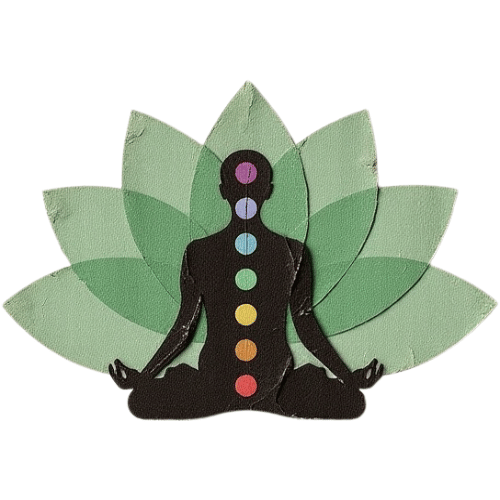
Through my work blending project management with somatic practices, I’ve identified six primary regions where overwhelm shows up. Most people have one or two dominant patterns.

Region 1: Crown/Third Eye (Head & Mind)

What it feels like:

  • Brain fog and difficulty focusing
  • Reading the same paragraph multiple times without retaining it
  • Racing thoughts you can’t shut off
  • Mental exhaustion even after sleeping
  • Tension headaches or eye strain
  • Information overload

What’s happening: Your cognitive capacity is genuinely maxed out. Your brain is trying to process too much incoming data—emails, messages, decisions, content, notifications. This isn’t “in your head”—your nervous system is signaling it needs space to process.

Common for: Knowledge workers, people in high-decision roles, anyone processing large amounts of information daily

Region 2: Throat

What it feels like:

  • Tension in your jaw, neck, or shoulders
  • Difficulty saying “no” even when you want to
  • Swallowing your words in meetings or difficult conversations
  • A sense of being unheard or misunderstood
  • Physical sensation of having something stuck in your throat
  • Tension around self-expression or visibility

What’s happening: Unexpressed thoughts and unspoken needs are creating internal pressure. You’re holding back communication that needs to flow—whether it’s boundaries at work, difficult conversations you’re avoiding, or simply speaking your truth.

Common for: People-pleasers, those in hierarchical environments, anyone who frequently “bites their tongue”

Region 3: Heart (Chest)

What it feels like:

  • Tightness or heaviness in your chest
  • Difficulty setting boundaries with people you care about
  • Absorbing others’ emotions and stress
  • Feeling responsible for everyone else’s well-being
  • Exhaustion from “keeping the peace”
  • Shallow breathing without realizing it

What’s happening: Emotional overwhelm is at the center of your stress. You’re likely navigating relationship dynamics, empathy fatigue, or the exhaustion of putting everyone else first. Your heart is working overtime—and it’s tired.

Common for: Empaths, caregivers, those in helping professions, parents, managers

Region 4: Solar Plexus (Upper Abdomen)

What it feels like:

  • Digestive issues or stomach tension when stressed
  • Difficulty delegating or asking for help
  • Harsh self-judgment when things aren’t perfect
  • Anxiety about being “enough” or doing “enough”
  • Butterflies or nausea before important events
  • Chronic tension in your core

What’s happening: You’re experiencing overwhelm around personal power, control, and self-confidence. There’s likely a battle between “I should be able to handle this” and “I’m completely overwhelmed.” Your inner critic is loud, and perfectionism might be running the show.

Common for: High achievers, perfectionists, those struggling with imposter syndrome

Region 5: Sacral (Lower Abdomen/Hips)

What it feels like:

  • Creative blocks or loss of inspiration
  • Disconnection from pleasure or joy
  • Difficulty playing, having fun, or feeling lightness
  • Tension in your lower back or hips
  • Feeling “dried up” or emotionally flat
  • Loss of flow state in your work

What’s happening: You’re experiencing depletion in your creative and emotional energy. There’s been too much output without enough replenishment—too much giving, creating, doing, without space to receive, rest, or simply be.

Common for: Creatives, entrepreneurs, parents, anyone in constant output mode

Region 6: Root (Legs, Feet, Base of Spine)

What it feels like:

  • Financial stress or worry about job security
  • Difficulty feeling settled or “at home” anywhere
  • Constant low-level anxiety about the future
  • Tension in your legs, feet, or lower body
  • Feeling ungrounded, scattered, or “floaty”
  • Restlessness or inability to be still

What’s happening: You’re experiencing overwhelm around basic survival needs—money, stability, safety, belonging. There’s anxiety about “Am I going to be okay?” running underneath everything else you’re trying to accomplish.

Common for: Anyone facing financial stress, job insecurity, major life transitions, or instability

How to Identify Your Pattern

Most people have awareness of where they hold stress, but they’ve never paid deliberate attention to it.

Try this simple exercise:

Think about the last time you felt overwhelmed. Close your eyes if it helps.

Ask yourself:

  • Where did I first notice sensation in my body?
  • What did it feel like? (Tight? Heavy? Racing? Numb? Fluttery?)
  • Did it stay in one place or move to other areas?
  • What did my body want to do? (Speak? Move? Curl up? Run? Cry?)

Write down your answers. You’ll likely notice a pattern.

Alternatively, track it for a week. Each time you feel stressed, note where you feel it in your body. Your dominant pattern will emerge.

Why This Matters for Productivity

Here’s where this connects back to sustainable productivity:

If you’re trying to be productive from a dysregulated nervous system, you’re fighting an uphill battle.

Your brain can’t focus when your chest is tight and your breath is shallow.

Your creativity is blocked when you’re depleted and running on empty.

Your decision-making suffers when your head is spinning and you’re disconnected from your body.

The most productive thing you can do is regulate your nervous system first. And you can’t regulate what you don’t understand.

When you know where YOU hold stress, you can intervene quickly:

  • Crown/Third Eye pattern? You need to reduce information input and create mental space
  • Throat pattern? You need to express or release what you’re holding back
  • Heart pattern? You need boundaries and self-compassion practices
  • Solar Plexus pattern? You need to release control and soften perfectionism
  • Sacral pattern? You need to prioritize pleasure and creative replenishment
  • Root pattern? You need grounding practices and safety-building routines

Different patterns need different solutions.

Discover Your Overwhelm Pattern

If you’re reading this and thinking “I have more than one pattern” or “I’m not sure which one is dominant”—that’s completely normal.

I created a free assessment that helps you identify your primary overwhelm pattern and gives you personalized practices based on YOUR nervous system.

It takes 3 minutes and maps your stress to one of these six body regions, then provides specific techniques that actually work for your pattern.

Because generic stress management doesn’t work. But targeted nervous system regulation? That changes everything.

Lisa Cantor | Smart Happy Space

About the Author: Lisa Cantor is a Project Management Professional (PMP) with 20+ years of experience, a certified Yin Yoga teacher, and Reiki Level II practitioner. She helps overwhelmed professionals build sustainable productivity by blending project management systems with nervous system regulation practices.

Why High-Performing Professionals Burn Out (And What Actually Helps)

Why High-Performing Professionals Burn Out (And What Actually Helps)

You’re good at what you do. Really good.

At work, you’re the person people count on. You hit deadlines. You manage complexity. You make things happen.

Your calendar is color-coded. Your task list is organized. You’ve tried every productivity app and system out there.

But here’s what no one sees:

You’re scrambling to get your kids to school on time. You’re forgetting to buy groceries—again. You’re snapping at your partner over something small. You’re lying awake at 2 AM with your mind racing through tomorrow’s to-do list.

You’re organized but exhausted.

I know this story intimately because I lived it for 20 years.

The Day I Realized Something Was Wrong

I was known as the calm, organized project manager who could handle anything. Perfect systems. Clear processes. Always prepared.

Then I’d get home and fall apart.

One morning, I was frantically searching for my daughter’s permission slip—the one I’d signed the night before but couldn’t find. I was already running late. My stress was radiating out so intensely that both my daughters were feeding off it, getting more anxious by the second.

That’s when it hit me: My daughters were absorbing my nervous system state.

No amount of better planning was going to fix this. The problem wasn’t my organizational skills. The problem was that my body was stuck in fight-or-flight mode from the moment I woke up.

I’m not alone in this. 82% of employees are at risk of burn out in 2025 according to recent research The Interview Guys. This isn’t a personal failing—it’s a systemic crisis affecting high-performing professionals across every industry.

What We Get Wrong About Burn Out

Here’s what most productivity advice misses:

You can’t organize your way out of a nervous system problem.

When you’re constantly running on stress hormones—even if you’re “functioning” well—your body eventually revolts. You might be hitting every deadline, but internally, you’re in survival mode.

The signs show up as:

  • Tightness in your chest or jaw
  • Shallow breathing without realizing it
  • Difficulty making decisions by end of day
  • Feeling “wired and tired” at the same time
  • Irritability over small things
  • Sunday night anxiety about the week ahead

You try to fix it with better systems. A new planner. A different app. More discipline.

But the exhaustion keeps growing.

Why Better Systems Aren’t Enough

Don’t get me wrong—I love a good system. As someone with over 20 years of project management experience, I still use Asana (for both personal and professional task management), time-blocking, and clear processes.

Systems are essential.

But they’re only half the equation.

The other half? Your nervous system.

When your body is chronically dysregulated—stuck in stress response—even the best productivity system becomes another source of pressure. Another thing you “should” be doing better.

You need both:

  • Cognitive tools (the systems, the planning, the structure)
  • Somatic practices (the body-based regulation that actually calms your nervous system)

This is what I call Grounded Productivity.

What Actually Helps

After years of trying to just power through my overwhelm, I finally started blending my project management expertise with nervous system regulation practices—yoga, breathwork, somatic awareness, Reiki.

The shift wasn’t about doing less. It was about doing things differently.

Here’s what changed:

Instead of just planning my day, I started checking in with my body’s energy. Is my chest tight? Am I holding my breath? What does my nervous system actually have capacity for today?

Instead of continuing to push myself forward when I felt stuck, I started taking 3-minute body check-ins. Not because I had time for it, but because it made everything else work better.

Instead of treating rest as a reward for completing my to-do list, I started treating regulation as the foundation that makes productivity possible.

The result? I’m still organized. I still use systems. But I’m not exhausted anymore.

And more importantly—my daughters aren’t absorbing my stress.

Where to Start

If you’re reading this and thinking “this is me,” here’s what I want you to know:

You’re not broken. You’re dysregulated.

And dysregulation has a solution.

Start here:

  1. Notice where you hold stress in your body. Is it your jaw? Your shoulders? Your chest? Your stomach? Just notice—no need to fix it yet.

  2. Take three conscious breaths before transitioning between tasks. Not because it’s “relaxing” but because it signals to your nervous system that you’re safe.

  3. Track your energy, not just your time. When do you feel most grounded? When do you feel most depleted? This data is as important as your task list.

These aren’t productivity hacks. They’re nervous system practices that make your productivity sustainable.

What’s Next

If you want to understand your specific overwhelm pattern—where stress shows up in your body and what that means—I’ve created a free assessment that maps your stress to one of six body regions.

It takes 3 minutes and gives you personalized insights and practices based on your pattern.

Because you don’t need to choose between being productive and being present.

You just need the right tools—for both your mind and your body.

Lisa Cantor | Smart Happy Space

About the Author: Lisa Cantor is a Project Management Professional (PMP) with 20+ years of experience, a certified Yin Yoga teacher, and Reiki Level II practitioner. She helps overwhelmed professionals build sustainable productivity by blending project management systems with nervous system regulation practices.